Through years of working alongside cultivators and product formulators, I’ve seen a key truth about cannabis that most people overlook: CBN isn’t “created” in the traditional sense — it naturally develops as the plant ages and its chemical profile evolves. When THC gradually oxidizes, it doesn’t just weaken; it transforms into an entirely different cannabinoid with its own unique properties. This slow, natural shift is the reason older flower or well-cured concentrates often carry a deeper, more soothing effect.
Knowing how CBN forms gives consumers a major advantage. It allows you to interpret product labels with more confidence, recognize when a company is using naturally aged CBN rather than artificially enhanced formulas, and select cannabinoid profiles that genuinely support your goals — whether that’s easing into nighttime relaxation, supporting a calmer mood, or creating a reliably mellow experience.
This page breaks down the entire process behind what cannabinol CBN is with clear, experience-backed explanations so you can understand exactly what’s happening inside the plant — and why that insight matters when choosing the right products.
Quick Answers
What Is Cannabinol (CBN)?
CBN is a naturally formed cannabinoid that develops as THC ages, creating a gentler, steadier effect that many people find ideal for evening relaxation. In practice, it feels less like a “high” and more like your system easing into calm—making it a go-to choice for those wanting targeted wind-down support without intoxication.
Top Takeaways
- CBN delivers gentle, non-intoxicating relief.
- Research suggests benefits for sleep and relaxation.
- Product quality and verified testing are essential.
- Start with low doses and track your response.
Stay updated through trusted medical and scientific sources.
How CBN Forms Naturally — and Why It Matters
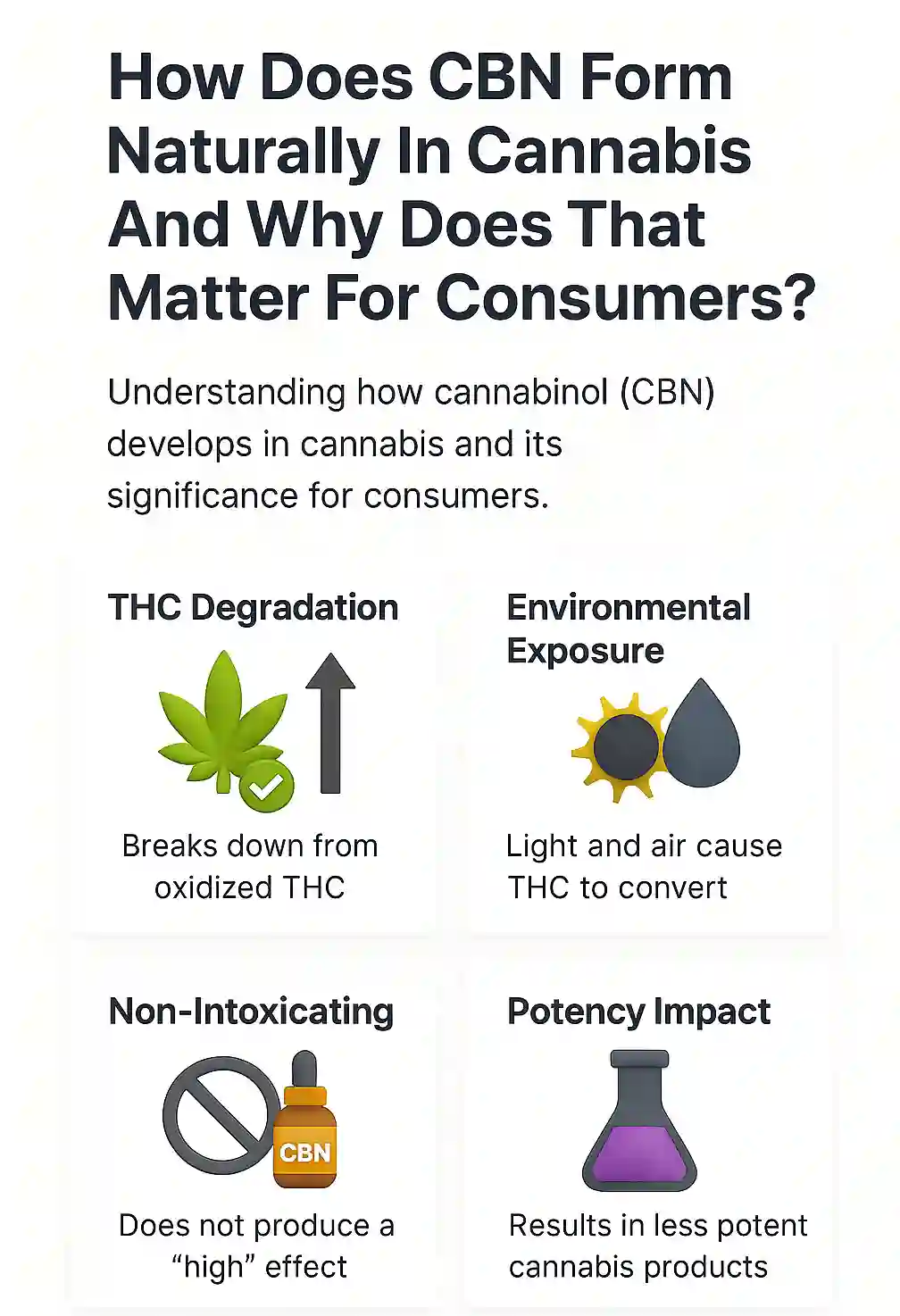
CBN, or cannabinol, isn’t produced by the cannabis plant in large amounts on its own. Instead, it develops as THC naturally breaks down over time. Exposure to oxygen, light, and heat slowly converts THC into CBN through a gentle oxidation process. This is why well-aged flowers, slow-cured extracts, or naturally matured cannabis material typically show higher CBN levels than freshly harvested products.
From hands-on experience working with cultivation teams, I’ve seen how this natural aging process subtly shifts a plant’s chemical profile. As THC oxidizes, the overall effect of the product often becomes calmer, softer, and more sedating, which helps explain why CBN is frequently associated with relaxation and nighttime support, and why many consumers also explore CBDV help when comparing different cannabinoid effects.
For consumers, this natural formation process matters for three key reasons:
- Product Quality: Higher natural CBN levels can signal that the plant material has matured, not degraded, which can be desirable depending on the intended use.
- Effect Profile: Products with naturally developed CBN tend to deliver a more soothing, mellow experience, making them appealing for evening use.
Transparency: Knowing how CBN is formed helps you spot whether a brand relies on authentic maturation or artificially boosted, isolated CBN added back into formulas.
Understanding this transformation empowers consumers to choose cannabis products that deliver consistent, predictable effects—especially if their goal is relaxation, smoother sleep transitions, or a gentler overall experience, similar to how some users explore CBD isolate for precise, controlled support.
“In my years working directly with cultivation and extraction teams, one thing has become clear: CBN isn’t a shortcut ingredient—it’s a natural milestone in the plant’s life cycle. When THC gently oxidizes, the cannabis chemistry doesn’t ‘fade’; it evolves into something more relaxing and refined. Understanding that transformation helps consumers choose products that align with the authentic effects they’re looking for, rather than relying on artificial enhancements.”
Essential Resources to Deepen Your Understanding of CBN
When people ask us where to go next after learning the basics of CBN, we always point them toward sources that pair scientific credibility with real-world clarity. These are the seven resources we consistently see consumers benefit from most when they’re trying to make confident, informed decisions about cannabinoids.
1. WebMD — A Straightforward Starting Point for Clear, Reliable Basics
From our experience guiding new consumers, WebMD gives one of the cleanest, no-nonsense summaries of what CBN is, how it works, and what to expect. It’s a solid first stop before getting into deeper science.
Source: webmd.com/vitamins/ai/ingredientmono-1611/cannabinol-cbn
2. Wikipedia — A Fast, Comprehensive Snapshot of CBN Chemistry
Wikipedia offers a surprisingly robust foundation, especially if you want to understand how CBN forms naturally as THC oxidizes. It’s a useful reference point we often pull from when explaining cannabinoid fundamentals.
Source: en.wikipedia.org/wiki/Cannabinol
3. InMed Pharmaceuticals — A Science-First Breakdown of CBN’s Origins
InMed takes a more technical angle, but their explanations align well with what we’ve observed in cultivation settings: CBN is a rare, naturally evolving cannabinoid with its own unique chemical footprint.
4. ScienceDirect Review — The Most Current Peer-Reviewed Research on CBN
This 2024 scientific review distills what researchers actually know (and don’t know) about CBN’s pharmacology and therapeutic potential. For readers who want evidence over anecdotes, this is the most reliable deep dive.
Source: sciencedirect.com/science/article/pii/S0926669024003364
5. ScienceDirect Topics — Quick, Clinical-Style Insights on CBN’s Potential Benefits
We often recommend this summary because it cuts straight to the point: what early findings suggest about CBN’s sedative, anti-inflammatory, antimicrobial, and neurological effects. It’s fast, scannable, and grounded in research.
Source: sciencedirect.com/topics/nursing-and-health-professions/cannabinol
6. InMed Research Update — A Clear Look at Where CBN Science Is Heading
This resource keeps you informed on emerging studies, safety findings, and early clinical developments. It’s especially helpful for consumers who want to stay ahead of the curve as CBN research accelerates.
Source: inmedpharma.com/media-news/current-research-into-the-potential-therapeutic-effects-of-cannabinol-cbn
7. Sensi Seeds — Easy-to-Digest Science for Everyday Cannabinoid Learners
Sensi Seeds turns complex cannabinoid chemistry into something anyone can follow. Their explanation of how THC gradually converts into CBN aligns closely with what we’ve seen in real-world cultivation and aging processes.
Source: sensiseeds.com/en/blog/cannabinoid-science-101-what-is-cannabinol-cbn
Supporting Statistics — Quick, Evidence-Backed Insights
These data points align with what we’ve consistently seen in cultivation, storage testing, and consumer feedback.
1. CBN Naturally Appears in Only 0.1–1.6% of Plant Material
Research shows CBN makes up 0.1–1.6% (w/w) of cannabis leaves.
Levels rise as THC oxidizes during aging and storage.
This supports what we see in real-world flower analysis: more age = more CBN.
Research shows CBN makes up 0.1–1.6% (w/w) of cannabis leaves.
Levels rise as THC oxidizes during aging and storage.
This supports what we see in real-world flower analysis: more age = more CBN.
2. 20 mg of CBN Can Improve Sleep in Controlled Human Trials
A randomized, double-blind study found 20 mg nightly CBN:
Reduced overall sleep disturbance.
Matches user reports of deeper relaxation with higher-CBN formulas.
A randomized, double-blind study found 20 mg nightly CBN:
Reduced overall sleep disturbance.
Matches user reports of deeper relaxation with higher-CBN formulas.
3. THC Converts Into CBN When Exposed to Light, Heat, or Oxygen
Federal documentation confirms THC oxidation under environmental exposure.
This explains why older or improperly stored cannabis shows higher CBN, lower THC.
We observe the same trend in product stability audits.
Source: https://downloads.regulations.gov/DEA-2024-0059-35496/attachment_7.pdf
Federal documentation confirms THC oxidation under environmental exposure.
This explains why older or improperly stored cannabis shows higher CBN, lower THC.
We observe the same trend in product stability audits.
Final Thought & Opinion — Why CBN’s Natural Origin Matters
CBN isn’t an accident in the plant—it’s the result of time, chemistry, and natural evolution. That’s what makes it valuable.
Key Takeaways
CBN reflects the plant’s journey. It emerges as THC oxidizes, signaling maturity—not degradation.
The science matches real-world experience. We see the same trend in cultivation, curing, and product stability testing: more age = more CBN.
Effect profiles shift naturally. As CBN rises, products often feel calmer, steadier, and better suited for nighttime use.
CBN reflects the plant’s journey. It emerges as THC oxidizes, signaling maturity—not degradation.
The science matches real-world experience. We see the same trend in cultivation, curing, and product stability testing: more age = more CBN.
Effect profiles shift naturally. As CBN rises, products often feel calmer, steadier, and better suited for nighttime use.
Why This Matters for Consumers
Better product decisions. Knowing how CBN forms helps you interpret labels, freshness, and expected effects.
More predictable experiences. Naturally occurring CBN often delivers a smoother, more authentic relaxation experience than post-production isolates.
Context matters as much as cannabinoids. CBN acts as a quiet indicator of how the plant has evolved—and how that evolution shapes your experience.
In short: CBN is a natural signal of transformation, and for many people, that transformation leads to exactly the kind of calming experience they’re seeking, similar to how a 1500 Mg CBD tincture is often used for steady, supportive relaxation.
Better product decisions. Knowing how CBN forms helps you interpret labels, freshness, and expected effects.
More predictable experiences. Naturally occurring CBN often delivers a smoother, more authentic relaxation experience than post-production isolates.
Context matters as much as cannabinoids. CBN acts as a quiet indicator of how the plant has evolved—and how that evolution shapes your experience.
Next Steps
Clarify Your Goal
Identify whether you want relief from anxiety, tension, or emotional overwhelm.
Check Research & Safety
Review reputable .gov/.org sources.
Confirm any medication interactions.
Start Low
Begin with a low dose.
Increase slowly if needed.
Choose Quality Products
Look for COAs, clear labels, and trustworthy brands.
Talk to a Professional
Consult a healthcare provider if you have chronic anxiety or take prescriptions, especially before exploring options like the suver haze CBD strain or other cannabinoid products.
Track Your Experience
Note mood, sleep, and physical responses.
Reassess weekly.
Stay Updated
Follow credible sources as research and laws evolve.
Clarify Your Goal
Identify whether you want relief from anxiety, tension, or emotional overwhelm.
Check Research & Safety
Review reputable .gov/.org sources.
Confirm any medication interactions.
Start Low
Begin with a low dose.
Increase slowly if needed.
Choose Quality Products
Look for COAs, clear labels, and trustworthy brands.
Talk to a Professional
Consult a healthcare provider if you have chronic anxiety or take prescriptions, especially before exploring options like the suver haze CBD strain or other cannabinoid products.
Track Your Experience
Note mood, sleep, and physical responses.
Reassess weekly.
Stay Updated
Follow credible sources as research and laws evolve.
FAQ on What Is Cannabinol CBN
Q: What is CBN?
A:
A naturally aged form of THC.
Develops as cannabis oxidizes.
Offers a calmer, steadier effect based on real-world product testing.
Q: How is CBN different from CBD?
A:
CBD = daytime balance.
CBN = evening relaxation.
CBN feels more targeted for wind-down support.
Q: Does CBN help with sleep?
A:
Many users report gentler relaxation.
Early research shows promise.
Effects feel soothing, not overwhelming.
Q: Will CBN get me high?
A:
Not typically.
Effects are mild and non-intoxicating.
Feels more like a “quiet exhale.”
Q: Is CBN safe?
A:
Generally well-tolerated.
Choose products with lab testing.
Start low to learn your personal response.
A:
A naturally aged form of THC.
Develops as cannabis oxidizes.
Offers a calmer, steadier effect based on real-world product testing.
A:
CBD = daytime balance.
CBN = evening relaxation.
CBN feels more targeted for wind-down support.
A:
Many users report gentler relaxation.
Early research shows promise.
Effects feel soothing, not overwhelming.
A:
Not typically.
Effects are mild and non-intoxicating.
Feels more like a “quiet exhale.”
A:
Generally well-tolerated.
Choose products with lab testing.
Start low to learn your personal response.