This guide walks through the etiquette habits that separate the players every pod wants in their next Magic: The Gathering game from the ones who quietly stop getting invited. Some of these habits date back to the kitchen-table years before Wizards started producing official Commander products in 2011. Others tie directly to the Commander Brackets system the format panel rolled out in February 2025. Every one of them matters if you want to play more Magic with more people while following proper magic the gathering mtg events etiquette.
TL;DR Quick Answers
Magic: The Gathering MTG Events Etiquette
Magic: The Gathering (MTG) events etiquette is the unwritten social code that governs how players behave at sanctioned tournaments, Commander pods, and Local Game Stores. The five rules that matter most:
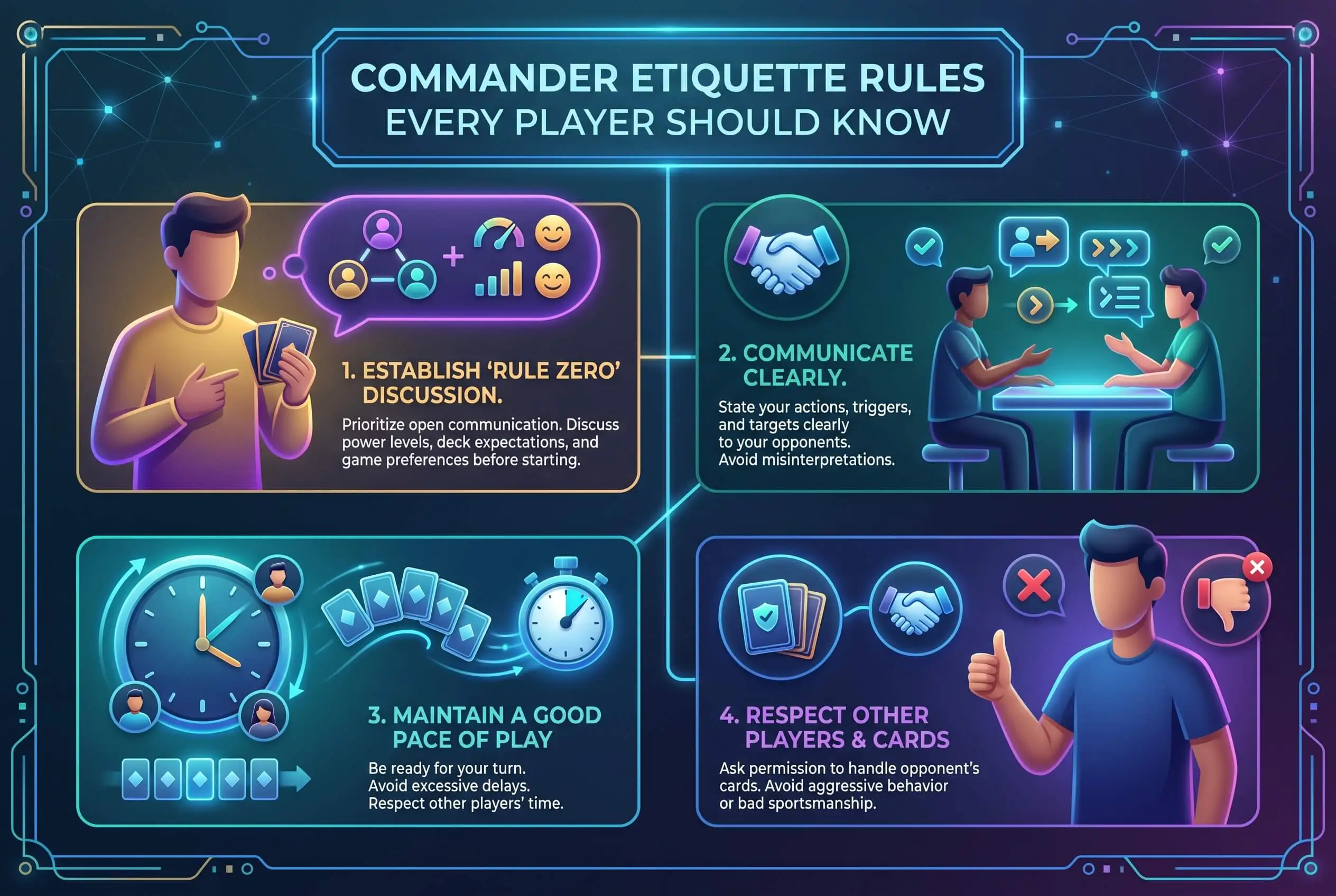
Have the rule zero conversation before shuffling. Talk power level, win conditions, and house rules with your pod.
Be honest about your deck's power level. Sandbagging is the single most damaging etiquette violation in Commander.
Keep pace of play reasonable. Plan during opponents' turns, especially at sanctioned events where round timers apply.
Disclose infinite combos, stax, and mass land destruction up front. Surprise lock pieces feel like ambushes.
Respect judges, the venue, and other players' cards. Clean sleeves, ask before touching cards, and pack up your seat when you leave.
Top Takeaways
Commander rewards good behavior almost as much as good decks, because the format is built on a four-player social contract.
The rule zero conversation is the single most important habit in EDH, and the new bracket system makes it easier than ever.
Sandbagging your deck's real power level is the most damaging etiquette violation, even more than slow play or salt.
How you lose matters more than how you win. Pods remember salt and dead-zone coaching far longer than blowouts.
LGS and tournament etiquette runs past the pod itself to sleeves, shuffling, the venue, and the people running the event.
Have the Rule Zero Conversation Before You Shuffle
Rule zero is the thirty-second pregame talk where the pod aligns on power level, win conditions, and house rules before the first card is drawn. Skip it and you've lost the social half of the game before the first land hits the table. Cover four things: what your deck is trying to do, how it usually wins, whether it runs infinite combos or stax pieces, and where it sits on the Commander bracket scale of 1 through 5. A casual theme deck shouldn't sit down across from a tuned Bracket 4 list without both players knowing in advance. Rather than replacing rule zero, the bracket system gives players a shared vocabulary that makes the conversation faster, and I've watched it cut pregame friction in half at recent CommandFests.
Be Honest About Your Deck's Power Level
Sandbagging means claiming a deck is weaker than it actually is so you can ambush a casual pod. It's the most damaging etiquette violation in Commander, and it poisons trust faster than any single bad game does. Calling your tuned Thoracle combo deck a casual brew because it doesn't run fast mana fools nobody once turn six hits and you untap into a Demonic Consultation line. If your deck packs Mana Crypt, two-card infinite combos, or a strong proactive plan, say so up front. A jank-but-spiky deck is fine. A deceptive one isn't. When the power gap shows up mid-game, scoop graciously instead of grinding to the kill. That single move buys back more goodwill than any post-game apology will.
Keep Pace of Play Reasonable
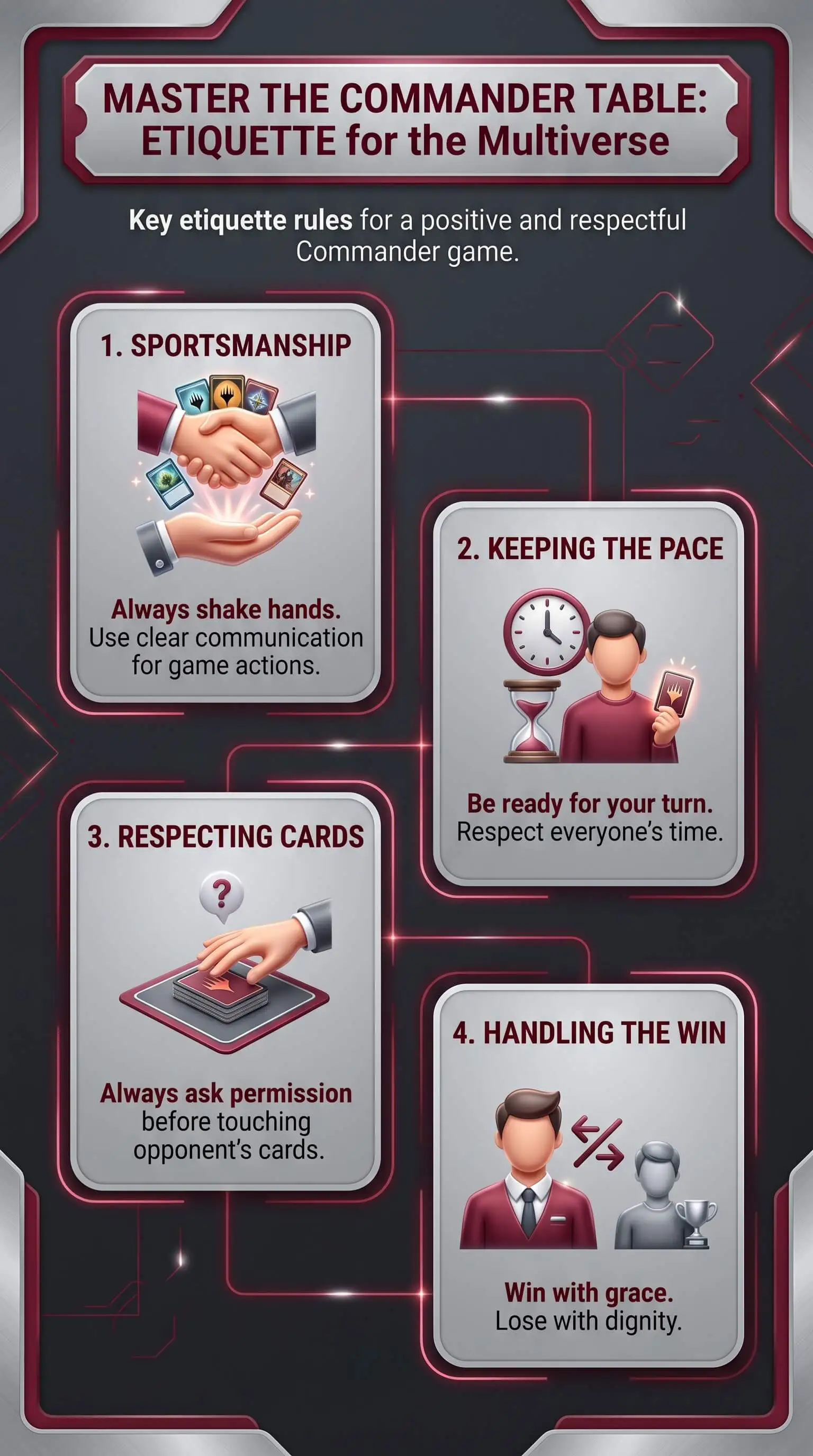
Slow play sits just behind sandbagging on the list of complaints pods bring to judge calls and LGS group chats, and it's the easiest item on that list to fix. Know your deck before you sit down. Plan your turn during opponents' turns. Don't pause to re-read every card in your hand each time priority passes. Call your actions clearly so the table doesn't lose track of the stack. Pace etiquette tightens at sanctioned MTG events and Friday Night Magic where round timers apply, and the same rule holds at the kitchen table. When one player eats forty percent of the clock, the four-player game stops being Commander and turns into solitaire with witnesses.
Handle Politics Without Becoming a Kingmaker
Kingmaking happens when a losing or eliminated player throws the game to a specific opponent for personal reasons instead of tactical ones. Politics belongs to the Commander. Threat assessment, deal-making, and "swing at me, I swing back next turn" negotiation are all fair play, much like the strategic positioning used by brand marketing agencies. What crosses the line is targeting one player because they made a joke you didn't like, because they beat you last week, or because their commander annoyed you on sight. If your decision is going to swing somebody else's win, base the call on the board state. Not the grudge.
Disclose Infinite Combos, Stax, and Mass Land Destruction
Infinite combos, stax lock pieces, and mass land destruction effects belong in the rule zero conversation, not in a surprise reveal on turn seven. A surprise Thassa's Oracle line or a Winter Orb hitting the board on turn three feels like an ambush even when the deck is technically legal. Stax strategies that lock opponents out of resources or turns can grind games into long, miserable affairs when the pod didn't sign up for that experience. Mass land destruction pulls more table-wide salt than any other single line in the format. None of these strategies are inherently rude. Hiding them is.
Manage Salt When You Lose
Salt is the lingering frustration a player carries after a blowout, a brutal mana flood, or a perceived slight at the table. Everyone gets salty sometimes. The etiquette lives in what you do with it. Don't rage-quit mid-game in a way that derails the pod. Don't coach the remaining players from the dead zone after you scoop, especially with information you saw in your hand. Don't relitigate the game for twenty minutes after it ends. A clean "good game," a deck shuffle, and a willingness to play another round is the etiquette ceiling. Pods remember how you lose longer than they remember how you win. That's been true at every table I've sat at since 2017.
Respect the LGS, Tournament, and Event Environment
LGS and event etiquette runs past the pod itself. Clean sleeves on a well-shuffled deck. Ask before you touch another player's cards. Call judges politely when you need a ruling, and never argue calls at the table. Take it to appeals if you have to. Pack up your seat before you leave it. Skip the strong cologne and the open food at the play area. For more on MTG events player etiquette at sanctioned tournaments and venues, this guide covers the situational stuff in depth. The short version: the store and the tournament organizer are doing you a favor by hosting Magic. Treat the space like it.
“After sitting at hundreds of Commander pods across LGS Friday nights, kitchen tables, and a handful of CommandFests since 2017, the pattern is consistent. The pods that work aren't the ones with the strongest decks or the most experienced players. They're the ones where everyone takes thirty seconds to talk before the first hand is shuffled. Gavin Verhey, who manages the Commander Format Panel at Wizards of the Coast, made the same point when the bracket system launched in February 2025: brackets exist to make rule zero easier, not to replace it. Skip the conversation and no matchmaking system in the world saves the game.”
7 Essential Resources
Wizards of the Coast Commander format page — the official rules and structure for the format, straight from the publisher.
Introducing Commander Brackets Beta — the official bracket system that replaced the old 1–10 power scale and reshaped rule zero conversations.
EDHREC — community deck data, archetype averages, and per-card salt scores pulled from real decklists.
Reddit r/EDH — the largest active community discussion of Commander norms, pod conflicts, and etiquette debates.
mtg.wiki Commander Brackets page — community-maintained reference covering every update Wizards has made to the bracket system since launch.
The Command Zone podcast — long-running EDH show with frequent episodes on rule zero, pod dynamics, and event etiquette.
MTGGoldfish Commander archive — deck analysis, format trend coverage, and strategy guides for every bracket of the format.
3 Statistics
Magic: The Gathering generated $1.72 billion in revenue in fiscal year 2025, a 59% jump over the prior year, making it the biggest single year in the game's history (Hasbro Investor Relations).
87% of MagicCon Chicago survey respondents said the Commander Brackets system was helpful in finding well-matched games during the 2025 beta test (Wizards of the Coast, April 2025 bracket update).
Commander is officially the largest format in Magic: The Gathering, a status confirmed in Wizards' own reporting and reinforced by the launch of the Commander Format Panel and bracket system (Wizards of the Coast, February 2026 update).
Final Thoughts and Opinion
After years at the table, Commander etiquette comes down to one question: do you treat a four-player game as a game everyone is playing, or as a game you're winning by yourself? The answer shows up in your behavior fast. The new bracket system Wizards rolled out is the best structural change the format has gotten in a decade, because it pushes rule zero from optional to default. Use it. Be honest about your deck, whether you prefer an mtg digital life counter app vs physical tracking method. Move at a pace your pod can keep up with. Skip the dead-zone coaching and the fifteenth-percent stall lines. Magic is too good a game and Commander is too good a format to lose pod invitations over behavior any player can fix in a single afternoon.
Frequently Asked Questions
What is rule zero in Commander?
Rule zero is the pregame conversation where Commander players agree on power level, win conditions, and any house rules before the first hand is drawn. It exists because Commander is a casual multiplayer format with no rigid rules around deck construction beyond the banlist, so pods have to align expectations themselves, much like seeking guidance from a healthcare professional before making important decisions.
Is it bad etiquette to play infinite combos in casual Commander?
Infinite combos aren't bad etiquette in themselves. Hiding them is. If your deck can win on turn six with an unannounced infinite, your pod feels ambushed even when the deck is technically legal. Disclose combos in the rule zero conversation and the issue mostly goes away.
How do I handle a player who takes too long on their turns?
Raise the issue politely between games, not during the turn. Suggest planning during opponents' turns and knowing the deck before sitting down. At sanctioned MTG events, slow play has formal remedies through the judge staff. In casual pods, the social fix usually works if it's framed as a pod-wide habit rather than a personal callout.
Are proxies acceptable in MTG Commander games?
Proxies are widely accepted in casual Commander pods and at kitchen tables, especially for expensive reserved list cards. They aren't legal at sanctioned events. The etiquette rule is simple: ask the pod before you sit down with proxies, and don't proxy a power level your deck wouldn't otherwise reach.
What's the difference between casual Commander and cEDH etiquette?
Casual Commander prioritizes pod balance, social fun, and rule zero. cEDH (competitive EDH) prioritizes optimal play, exact decklists, and tournament-style behavior. The etiquette layer is similar in honesty, pace, and no kingmaking, but cEDH players expect every line to be played for maximum efficiency, and slow play tolerance is much lower.
How should I handle losing in Commander without becoming salty?
Scoop cleanly, say "good game," and resist the urge to coach the remaining players or replay the loss out loud. A short break, a deck shuffle, and the next pod is the etiquette ceiling. Salt happens to everyone. The etiquette is what you do with it.
Call to Action
Try one thing in your next Commander game. Take thirty seconds before the first hand is shuffled to walk your pod through your deck's bracket, win conditions, and combo lines. The shift in game quality is usually immediate. Share this guide with the friends who keep ducking your invites, or, more honestly, with the player in your pod who needs it most.